 PickGlobe

A great outfit doesn't have to be custom-made. But it should look as though someone paid attention to the shoulders, sleeves, and how the fabric moves when you do. The fastest rule? Fit the hard-to-alter areas first, then tailor the details.
📌 Quick answer
- Shoulders first: they are the hardest part to alter, so buy for the shoulders.
- Button the jacket: lapels should lie flat, with no X-shaped creases at the button.
- Sleeves: a jacket sleeve near the wrist bone usually shows ¼–½ inch of shirt cuff.
- Dress shirt: the collar should feel secure but not tight, and buttons should not pull.
- Tailor the small things: sleeve length and modest waist shaping are common fixes.

👔 The quick fit comparison
| Fit point | Suit jacket | Blazer | Dress shirt |
|---|---|---|---|
| Shoulders | Clean, structured line; no overhang or dents | Same principle, often softer construction | Seam close to the natural shoulder edge |
| Chest | Lapels lie flat; button closes without strain | Comfortable over intended layers | No pulling at buttons; room to breathe |
| Waist | Gentle shape; no X-shaped creases | May be more relaxed or unstructured | Follows body without billowing or clinging |
| Sleeves | Usually show ¼–½ in (0.6–1.3 cm) of shirt cuff | Similar with a dress shirt; casual styling varies | Buttoned cuff sits around wrist hinge |
| Length | Traditional styles generally cover the seat | Can be a little shorter depending on style | Long enough to stay tucked if intended |
These are starting points, not universal rules: body proportions, garment construction, and styling change the ideal result.
🧥 How a suit jacket should fit
1. 📏 Start at the shoulders
The shoulder line should look smooth and intentional. A structured jacket's seam typically finishes at or just beyond your natural shoulder, depending on its construction. Watch for upper-sleeve dents, bulging shoulder pads, or fabric pulling across your upper back. Major shoulder alterations are complicated and costly—don't buy a badly fitting shoulder hoping a tailor will rescue it.
2. 🔘 Button it and look for an X
Fasten the jacket's appropriate front button while standing naturally. The lapels should lie flat, and the front should close without radiating X-shaped tension lines from the button. A little shape at the waist is flattering; visible strain is not. Check that you can breathe, sit, and move your arms comfortably.
3. ✂️ Check the collar, hem, and sleeves
The jacket collar should sit against your shirt collar without a conspicuous gap at the back of the neck. For a traditional suit, the hem generally reaches around the bottom of your seat, though fashion-forward cuts vary. With your arms relaxed, a useful starting point is a jacket sleeve near the wrist bone, revealing ¼–½ inch of dress-shirt cuff.
💡 Mirror test: Stand straight, button the jacket, turn sideways, then lift and lower your arms. If the jacket only looks right when you stand perfectly still, try another size or cut.
🧥 What changes with a blazer?
A blazer follows many of the same fit rules as a suit jacket, but it's often worn separately with chinos, jeans, or knitwear. Unstructured blazers can drape more softly, and casual styles may be intentionally shorter. Try yours over the actual shirt or sweater you plan to wear; layering changes how the chest and sleeves feel. A blazer should still sit cleanly at the shoulders and move without pulling.
👕 How a dress shirt should fit
Collar: Button the top button if you'll wear a tie. It should feel secure, not constricting. A common fitting-room check is whether one or two fingers fit comfortably inside, but finger sizes differ—comfort matters more than the trick.
Shoulders and chest: The shoulder seam should land close to the edge of your shoulder. The placket should stay flat without buttons pulling open. Reach forward and cross your arms; the upper back should allow normal movement.
Waist and hem: Slim doesn't mean skin-tight. A fitted shirt should follow your shape without stretched buttons, while a classic fit allows extra room. If you plan to tuck it in, raise your arms and sit down to check that the hem stays put.
Sleeves: With arms at rest and cuffs buttoned, the cuffs generally end around the wrist hinge or just beyond the wrist bone. Excess fabric shouldn't pile dramatically at the cuff, but you need enough length to reach forward.
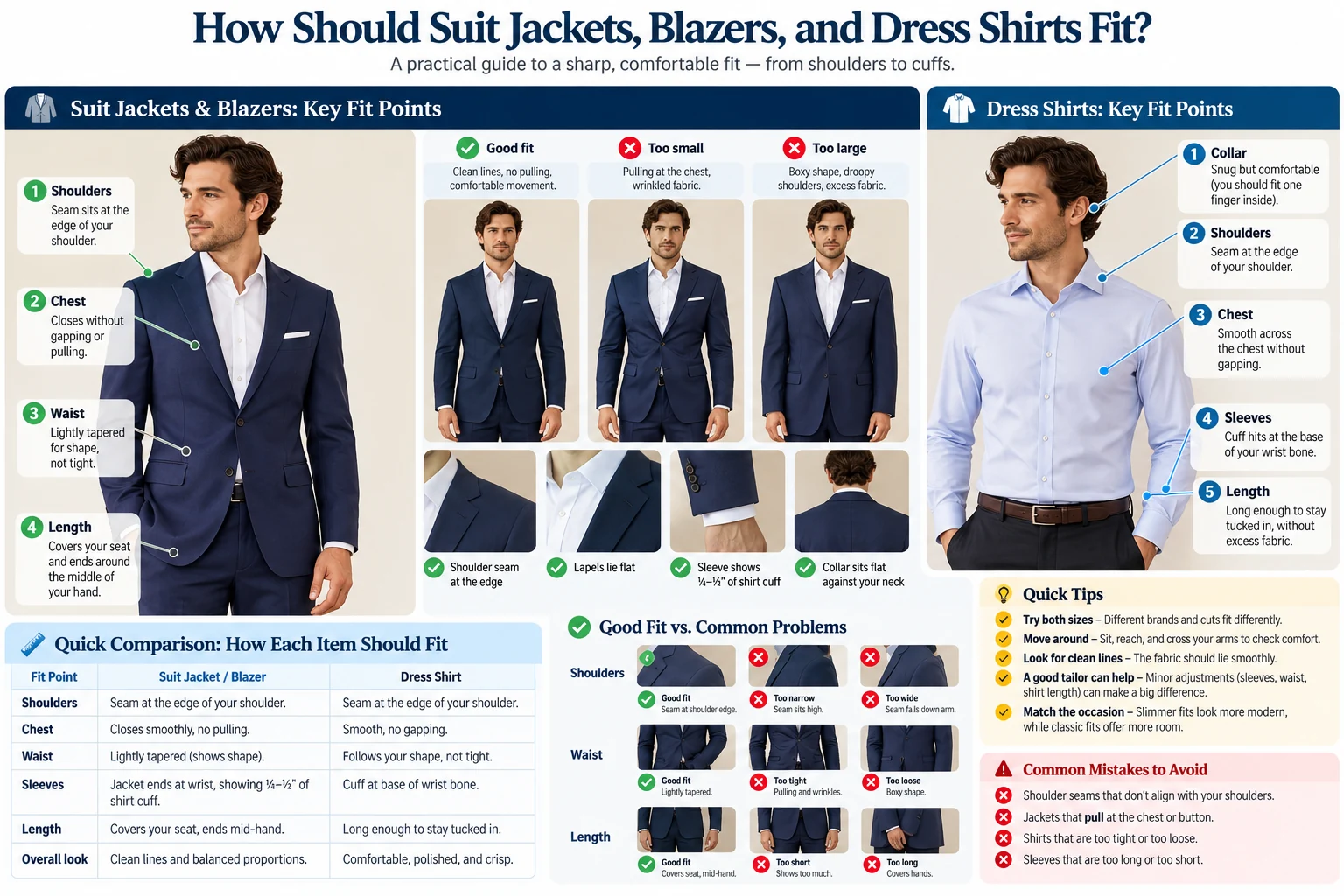
Illustration: AI-generated. Visual overview: use the detailed checks below to confirm fit. Illustration is conceptual; always check garment construction and comfort.
⚠️ Too tight, too loose, or fixable?
| Symptom | Likely issue | What to do |
|---|---|---|
| X-shaped wrinkles at jacket button | Jacket waist/chest too tight | Try a different cut or size; ask a tailor about available seam allowance |
| Dents below jacket shoulders | Shoulder shape/width mismatch | Try a different jacket; major alterations rarely worth it |
| Collar gap behind neck | Balance or collar fit issue | Compare another cut; consult an experienced tailor |
| Shirt buttons gape | Shirt chest or waist too small | Size up or choose a roomier fit |
| Jacket sleeves slightly long | Sleeve length | Often alterable, but functional cuff buttons complicate work |
| Shirt waist billows | Excess fabric | Tailoring darts or side-seam adjustments may help |
| Jacket body far too long | Overall proportion wrong | Prefer another length; substantial shortening can upset pocket placement |
🪡 What should you tailor—and what should you leave alone?
Sleeve shortening and modest waist shaping are common alterations, although construction and available fabric determine what's possible. Rebuilding jacket shoulders, changing the chest extensively, or dramatically shortening a jacket is much more involved. Buy for shoulders and overall balance; tailor small refinements. Get an alteration quote before removing tags.
⏱️ The two-minute fitting-room checklist
- Look straight on: Are shoulders clean and lapels flat?
- Button up: Any pulling, gaping, or strain?
- Turn sideways: Does the jacket length balance your torso and legs?
- Check cuffs: Do shirt and jacket sleeves work together?
- Move: Sit, reach, and walk. Does anything bind?
- Compare fits: Try classic, slim, and relaxed cuts rather than assuming your usual label size will work.
🎯 Final takeaway
The best-fitting suit jacket, blazer, or dress shirt isn't necessarily the tightest. It's the one that drapes cleanly, feels comfortable in motion, and suits how you'll actually wear it. Prioritize shoulders and overall proportions, then let a tailor handle the small finishing touches.
🔗 Related guides
- Buying a suit online: sizing and fit
- How to measure your chest, waist and hips at home
- Before you order from Rowe & Taylor: returns, hemming and shipping terms
- How to read clothing size charts online
What we could not confirm
- The fit rules above are general tailoring guidance. They come from the sources below, which the author of this guide listed. We did not re-open them, and we have not tested any garment or store.
Sources used by the author (accessed 23 October 2026; not re-checked by us): Proper Cloth, how jacket shoulder width should fit; Proper Cloth, advanced tips for tailored jacket fit; Charles Tyrwhitt, sizing guides; Charles Tyrwhitt, how to measure for a shirt; Men's Wearhouse, how should a suit fit.