 PickGlobe

Learning guitar appeals to people for a simple reason: with a few chords, you can begin accompanying songs you already love.
But guitar isn't the only good first instrument. A keyboard makes musical patterns easier to see, a ukulele can feel approachable in small hands, and drums put rhythm front and center.
If guitar is the sound that excites you, a structured beginner course can turn that interest into a realistic learning routine.
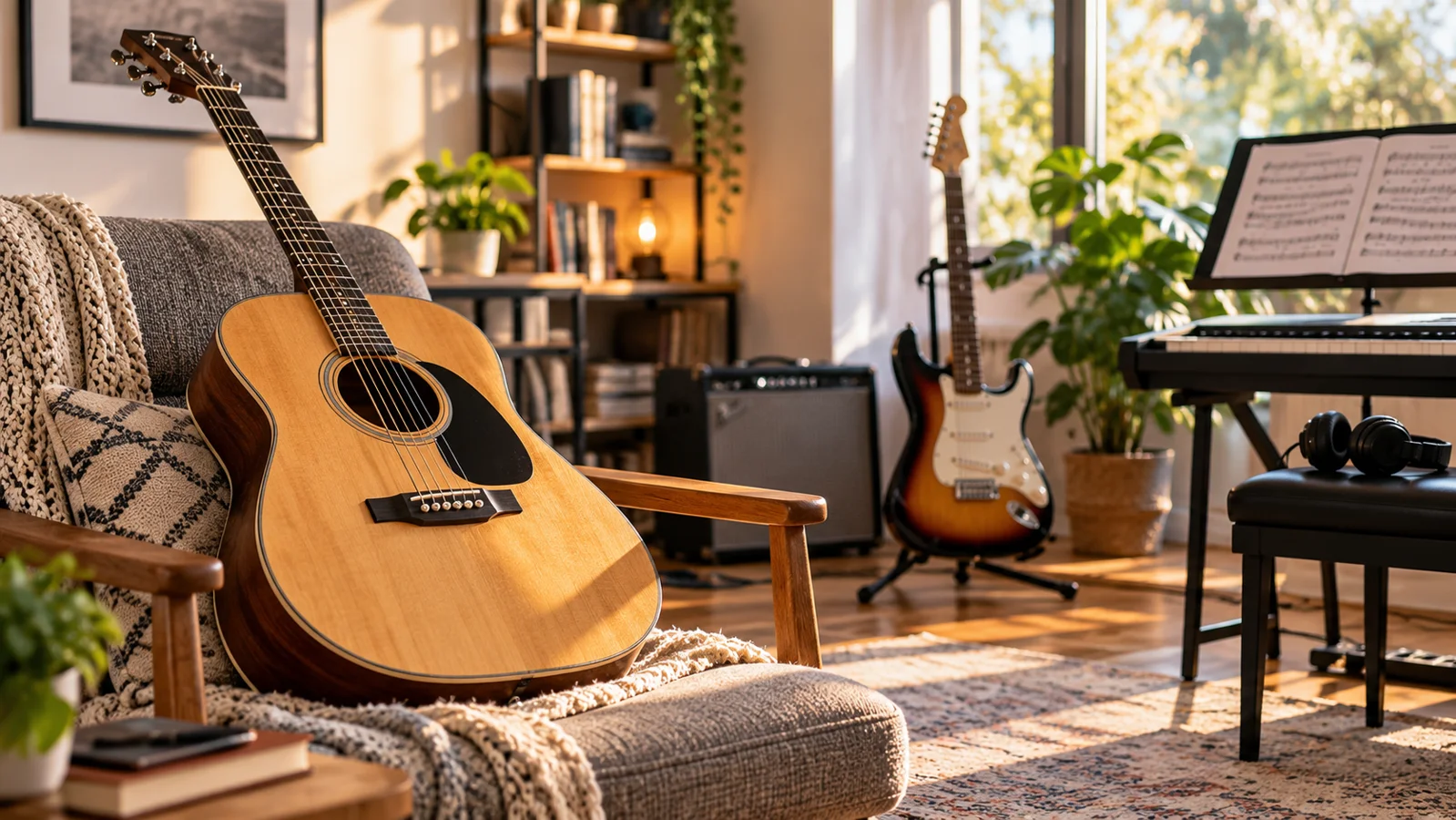
Why learn a musical instrument at all?
Making music gives you a creative skill you can use alone or with other people. You can play for relaxation, accompany a friend singing, join a band, write a song, or simply enjoy noticing your own improvement. Practicing also asks you to listen closely, coordinate movement, and solve small problems—like switching chords without losing the beat.
There is some scientific evidence of cognitive benefits from musical training, but avoid the dramatic claims. A 2024 systematic review and meta-analysis of studies involving older adults found improvements in some executive-function and processing-speed measures, not consistent gains across every memory or attention outcome. That research does not prove guitar lessons raise everyone's IQ or prevent dementia. Enjoyment and a satisfying new skill are reasons enough to begin.
Why guitar is such a compelling first instrument
🎸 You can make recognizable music early. A small collection of chords can accompany many songs, even before you learn scales or read notation.
It travels reasonably well. An acoustic guitar doesn't need electricity or a speaker. You can take it to a friend's house or practice in a small room.
It covers a lot of musical ground. Folk, rock, blues, country, pop, jazz, and classical music all make room for guitar, though the techniques differ.
It grows with you. You might start with chord strumming, then explore fingerpicking, melodies, improvisation, recording, or songwriting.
The catch? Your fingertips may be tender at first, changing chords takes coordination, and poorly adjusted strings can make any guitar unnecessarily frustrating. If an instrument is unusually hard to press, a shop can check its action (string height).
Guitar vs. piano, ukulele, and drums: how do they compare?
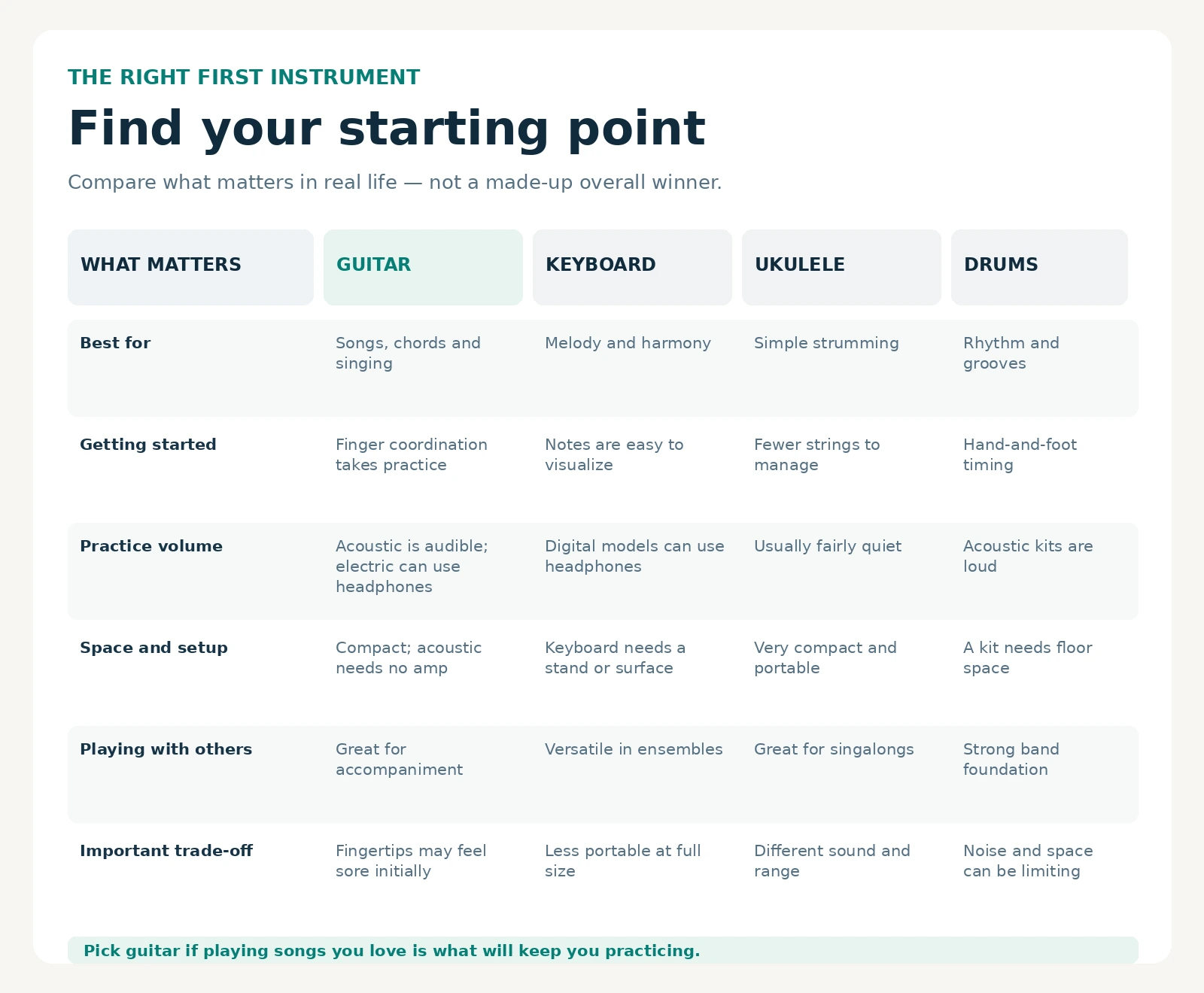
| If you care most about… | A strong starting point | Why |
|---|---|---|
| Singing along to favorite songs | Guitar or ukulele | Strummed chords can support your voice. |
| Seeing how notes and harmony work | Keyboard or piano | The linear keys make patterns easy to visualize. |
| A small, lightweight instrument | Ukulele | Compact, with four strings on common models. |
| Rhythm, energy, and playing in a group | Drums | Direct focus on timing and grooves. |
| A flexible solo-and-accompaniment instrument | Guitar or keyboard | Both can handle melody and harmony. |
| Quiet headphone practice | Digital keyboard or suitable electric setup | Headphone capability depends on the gear. |
No instrument wins every category. An acoustic drum kit is loud, but an electronic kit with headphones can suit shared spaces. An acoustic guitar is portable, but a steel-string model may initially be harder on fingertips than a well-set-up electric guitar or nylon-string classical guitar.
Acoustic, electric, or classical guitar?
Steel-string acoustic: A straightforward choice for singer-songwriters, folk, country, and casual strumming. No amplifier needed; the thicker body and string tension may take getting used to.
Electric: A natural fit for rock, blues, indie, and riff-driven music. Many electric guitars have lighter-feeling strings and a slimmer body. To hear amplified tones, budget for an amplifier or compatible headphone solution and a cable.
Nylon-string classical: Worth trying if you love classical, flamenco, or a softer sound. Nylon strings often feel gentler on fingertips, although the neck can be wider.
💡 Choose the sound you actually love. You do not have to master acoustic guitar before starting electric. The fundamentals transfer between the two, and motivation matters more than an imagined mandatory sequence.
What your first month in a beginner guitar course might look like
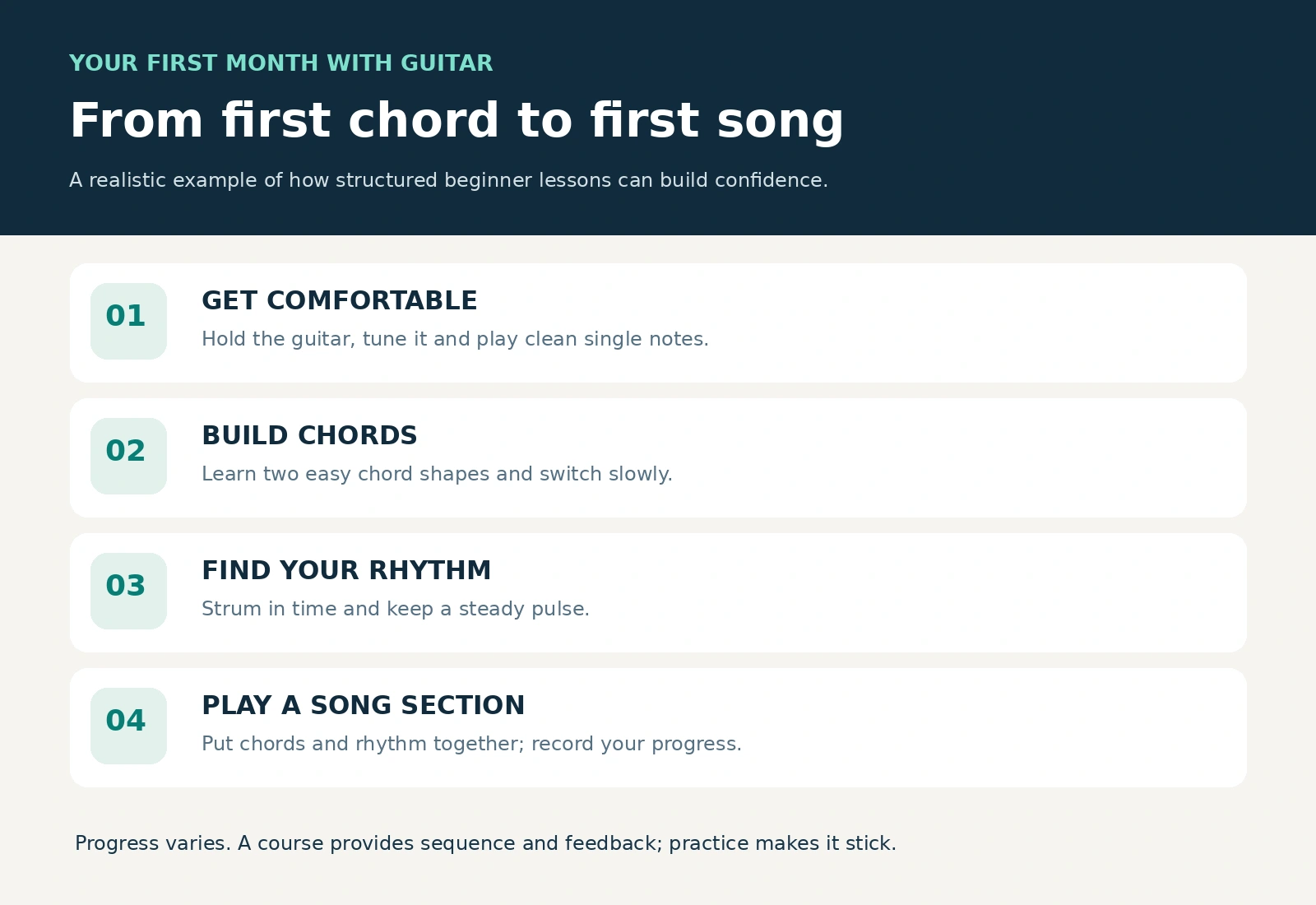
A well-structured beginner guitar course typically breaks the basics into manageable steps, with demonstrations you can replay and a clear order for what to practice next. Start with 10–15 minutes most days, rather than waiting for a perfect hour-long practice window. Here is an illustrative sequence (actual course syllabi vary):
- Week 1 — Meet the instrument. Learn to hold it comfortably, tune the strings, and pick clear single notes.
- Week 2 — Learn two chords. Try Em and Am, then practice switching slowly while keeping your hands relaxed.
- Week 3 — Add rhythm. Count a steady beat and strum an easy pattern. Accuracy matters more than speed.
- Week 4 — Play a short song section. Combine a few chords, record yourself, and notice one thing you improved.
If a chord feels impossible, slow down, place one finger at a time, and check that you're pressing just behind the fret. Mild fingertip tenderness can be common early on; sharp or persistent pain is a reason to stop and review technique or setup.
What do you actually need to begin?
Keep the first setup simple: a comfortable, properly sized guitar, a tuner (a clip-on tuner or reliable app), and a few picks if you want to strum with one. A gig bag or case protects it in transit. Electric players will also need a way to hear the instrument—an amplifier or compatible audio setup—and usually a cable. A teacher or structured beginner course can provide a clear progression instead of leaving you to assemble random tutorials. Look for beginner lessons that cover tuning, posture, chord changes, timing, song practice, and ways to check your technique.
Before buying, try holding a few instruments if possible. Check whether you can reach around the neck comfortably, whether the body feels manageable, and whether the strings press down without excessive force. A well-set-up modest instrument is more useful than an expensive one you dread playing.
Why choose a structured beginner guitar course?
Free videos can help you learn individual songs, but beginners often struggle to decide what to learn next. A well-designed course offers a sequence: start with tuning and hand position, move into simple chords and rhythm, then combine those skills in songs. The main advantage is less guesswork about your next practice session, not a guarantee that everyone progresses at the same speed.
Before enrolling, check the course level, lesson previews, instrument requirements, instructor credentials, accessibility features, refund terms, and whether there is any feedback or community support. Only choose a course whose approach fits the music you want to play.
Ready to look at one? See the Learn Guitar for Beginners course for adults (an ad) and check its syllabus, previews and refund terms against the list above.
So, is guitar the right instrument for you?
If you love songs, want to accompany your voice, or dream of playing riffs, guitar is a strong place to start. If you are drawn to melodies and harmony laid out visually, try a keyboard; if portability is everything, try a ukulele; if rhythm makes you move, try drums.
Your first milestone is not perfection: it is playing a little more confidently each week. A beginner course can give that progress a plan.
Next step: read the beginner guitar course page (an ad) and decide whether its lessons match the music you want to play.
What we could not confirm
- We have not taken the beginner guitar course linked here, and we have not seen its lessons. Nothing above is a claim about its content, price, results or refund terms: check the course page before you buy.
- The practice plan and instrument comparison are general editorial advice, not tested outcomes.
- The cognitive-benefit paragraph rests on one 2024 review of studies in older adults and does not apply to every learner.
Last reviewed: 23 October 2026. Sources, as listed by the package author and not re-opened by us: Fender, acoustic vs electric guitars for beginners; Fender, 10 beginner FAQs; Argos, choosing the right musical instrument; PubMed, musical instrument training in healthy older adults: systematic review and meta-analysis (2024).